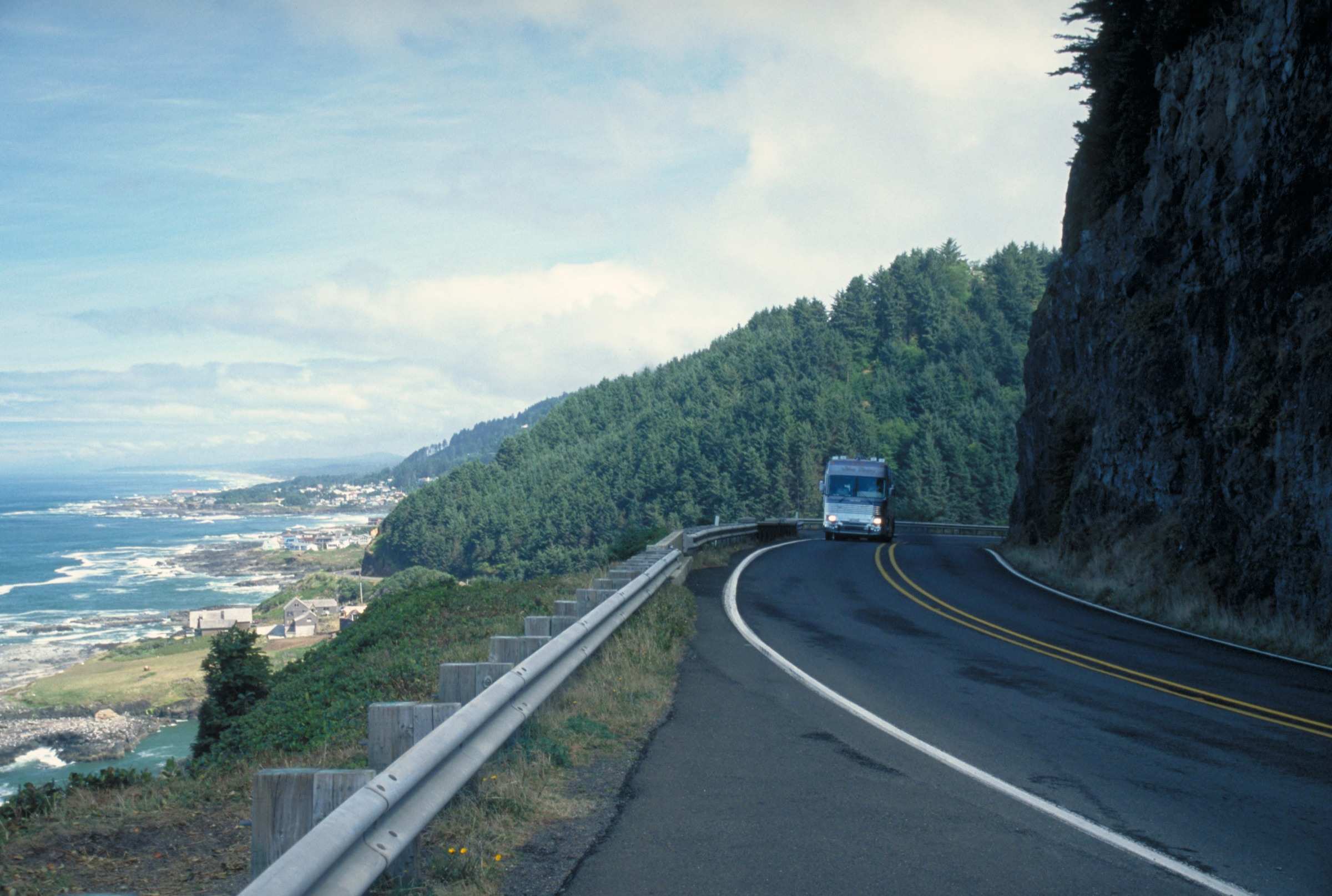
Representation for people injured in commercial truck crashes.
A crash with a semi, a log truck, or a delivery truck is not an ordinary car accident claim. A trucking company, its insurer, and a body of federal safety rules are involved from the first day. We deal with the carrier and its insurer so you can focus on getting well.
Most Oregon truck accident injury claims must be filed within two years of the crash under ORS 12.110. For-hire interstate carriers hauling general freight in trucks rated at 10,001 pounds or more must carry at least $750,000 in liability coverage (49 CFR 387.9), and federal rules require carriers to keep driver hour logs for only six months (49 CFR 395.8(k)), so evidence should be requested early.
How a truck crash claim is different
A truck crash claim usually involves more people, more rules, and more records than a collision between two cars. Those differences shape the work from the start.
Who is responsible. Beyond the driver, a claim can reach the motor carrier that employed or dispatched the driver, the owner of the truck or trailer, a company that loaded the cargo, or a shop that maintained the equipment. Under Oregon law an employer is generally responsible for the negligence of an employee acting within the course and scope of the job.
The safety rules. Interstate carriers must follow the Federal Motor Carrier Safety Regulations, which limit driving hours (49 CFR Part 395), set driver qualification standards (Part 391), and require inspection and maintenance (Part 396). Oregon adopts most of those rules for trucks operating within the state (OAR 740-100-0010). A violation can be evidence of negligence.
The records. Driver logs, inspection and maintenance files, post-crash test results, and data stored on the truck can show what happened and why. Some of it has to be kept for only a limited time, so we ask the carrier in writing, early, to preserve it.
The insurance. Commercial policies are larger than personal auto policies, and carriers and their insurers often begin their own investigation right away. We deal with them directly, and if an offer isn't fair we are ready to present your case to a jury, at your request.
Read the guide: ORS 31.600: Oregon Comparative Negligence and the 51% Bar
Truck Accidents questions
Who can be held responsible for a truck accident in Oregon?
Often more than one party. Depending on the facts, a claim may be brought against the truck driver, the motor carrier that employed or dispatched the driver, the owner of the truck or trailer, a company that loaded the cargo, or a business that maintained the equipment. Under Oregon law an employer is generally responsible for the negligence of an employee acting within the course and scope of the job.
How long do I have to file a truck accident claim in Oregon?
Most injury claims must be filed within two years of the crash under ORS 12.110. A wrongful death claim generally must be filed within three years under ORS 30.020. If a public body is involved, such as a city, county, or state vehicle, the Oregon Tort Claims Act requires written notice within 180 days, or one year for wrongful death (ORS 30.275).
How much insurance does a trucking company have to carry?
Federal law sets the minimum for trucks in interstate commerce. Under 49 CFR 387.9, a for-hire carrier hauling general, nonhazardous freight in a truck rated at 10,001 pounds or more must carry at least $750,000 in liability coverage. The minimum rises to $1,000,000 for oil and certain hazardous materials, and to $5,000,000 for the most dangerous hazardous cargo. Carriers that operate only inside Oregon are regulated by the Oregon Department of Transportation under ORS chapter 825. What is actually available depends on the carrier and its policies.
How many hours can a truck driver legally drive?
Under 49 CFR 395.3, a driver hauling freight may drive up to 11 hours within a 14-hour window that begins after 10 consecutive hours off duty, and must take a 30-minute break after 8 hours of driving. A driver also may not drive after 60 hours on duty in 7 days, or 70 hours in 8 days, depending on the carrier's schedule. Some short-haul and in-state operations follow different limits. Records that show a violation can be important evidence.
What evidence matters after a truck crash, and how long is it kept?
Federal rules require carriers to keep driver hour logs and supporting documents for at least six months (49 CFR 395.8(k)), inspection and maintenance records for one year (49 CFR 396.3), and an accident register for three years (49 CFR 390.15). After a fatal crash, and after certain injury crashes in which the truck driver is cited, the carrier must test the driver for alcohol and drugs (49 CFR 382.303). Data stored on the truck itself can be lost when the truck is repaired or put back in service. A written request to preserve evidence, sent early, asks the carrier to keep all of it.
The trucking company's insurer called me. Do I have to give a statement?
No. You are not required to give a recorded statement to the trucking company's insurer, and an early statement can be used to limit the claim later. Call us before any recorded statement.
What if I was partly at fault?
Oregon's modified comparative negligence rule, ORS 31.600, allows you to recover as long as you are not more than 50% at fault. Your damages are reduced by your share of fault. We'll explain how it applies to your specific facts.
What if a truck crash took the life of a family member?
Oregon's wrongful death statute, ORS 30.020, applies. The claim is brought by the personal representative of the person's estate for the benefit of the surviving family, and it generally must be filed within three years.